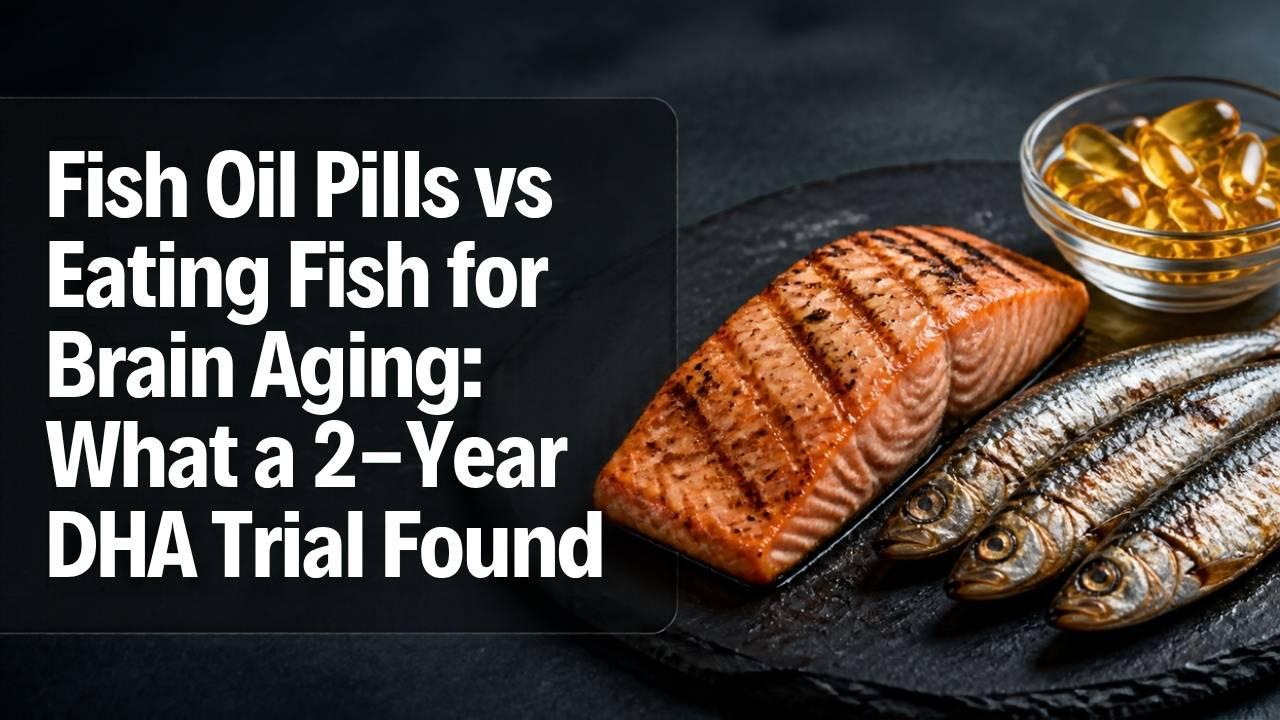
Fish Oil Pills vs Eating Fish for Brain Aging: What a 2-Year DHA Trial Found
TL;DR: In a 2-year USC trial of 365 adults aged 55 to 80, 2 g of DHA a day raised DHA in spinal fluid by 17% but did not change memory scores or hippocampal volume. People who eat more fish have about 18% lower rates of cognitive decline in observational studies, but that evidence cannot prove fish is the cause. Verdict: eat fish for the whole diet pattern; do not count on a DHA capsule to protect your brain.
Table of Contents
- Why This Comparison Matters
- Head-to-Head: Fish Oil Pills vs Eating Fish
- Option A: High-Dose DHA Pills (What the Data Shows)
- Option B: Eating Fish (What the Data Shows)
- Why the Two Answers Differ
- What I Would Actually Do
- FAQ
- References
Why This Comparison Matters
DHA (docosahexaenoic acid) is the main omega-3 fat in the brain. It sits in the membranes of nerve cells, and people with low blood DHA are more likely to show cognitive decline and Alzheimer’s disease in long-term studies. That link is the reason fish oil became one of the most popular “brain” supplements for people over 50.
The problem is that a link in blood tests is not the same as a benefit from a capsule. For years, supporters of fish oil had a ready explanation for disappointing trials: the dose was too low, or the DHA never reached the brain. In July 2026 a team at the University of Southern California published a trial in eBioMedicine designed to remove both excuses. They gave a high dose, and they measured DHA directly in the fluid around the brain.
At the same time, the evidence for eating fish keeps pointing in a favorable direction. So if you are deciding where to put your money and effort, the real question is not “is DHA good for the brain?” It is “does a DHA pill do what a fish-rich diet seems to do?” Those are two different questions with two different answers.
Head-to-Head: Fish Oil Pills vs Eating Fish
| High-dose DHA pills | Eating fish | |
|---|---|---|
| Best evidence | Randomized, double-blind, placebo-controlled trial (PreventE4, n = 365, 24 months) plus a 38-trial meta-analysis | Meta-analysis of 35 observational studies |
| Effect on cognition | No difference vs placebo (RBANS change +2.76 vs +2.67) | 18% lower risk of cognitive impairment or decline, highest vs lowest intake |
| Effect on brain structure | No significant effect on hippocampal volume over 24 months | Not measured in the pooled analysis |
| Dementia risk | Not tested as an outcome; earlier trials found no reduction in new dementia | 18% lower dementia risk, 20% lower Alzheimer’s risk (associations) |
| Can it prove cause? | Yes, for what was measured | No. Fish eaters differ in many other ways |
| Did it reach the brain? | Yes: spinal-fluid DHA up 17% | Not measured |
| Practical cost | Five 400 mg capsules a day in the trial | 1 to 2 seafood meals a week (AHA, for heart health) |
| Side effects | Adverse events similar to placebo (40.3% vs 40.9%) | Mercury exposure depends on the species you choose |
Option A: High-Dose DHA Pills (What the Data Shows)
The PreventE4 trial
The trial, led by Hussein Yassine at the University of Southern California and funded by the US National Institute on Aging and the Alzheimer’s Drug Discovery Foundation, ran from September 2018 to May 2024 (registered as NCT03613844). It enrolled 365 adults aged 55 to 80 with normal cognition. Everyone had to eat little DHA at baseline (under 200 mg a day; the median was about 85 to 89 mg) and have at least one risk factor such as obesity, high blood pressure, high cholesterol or low physical activity.
The average age was 66.4 years, 58% were women and 39% were Hispanic. Because the APOE4 gene variant raises Alzheimer’s risk and changes how the body handles omega-3 fats, the researchers deliberately enriched the group: 173 participants, or 47%, carried APOE4. Randomization was stratified by carrier status, so both groups had a similar share.
Half took 2,000 mg of DHA a day as five 400 mg capsules, three with breakfast and two with the evening meal. The other half took identical capsules filled with a corn and soybean oil mix. All participants also received a standard B-vitamin complex. A subgroup agreed to lumbar punctures so the team could measure DHA in cerebrospinal fluid, the most direct way to see whether a supplement is reaching the brain in living people.
It reached the brain
On its primary goal, the trial was a clear success. Among 167 participants with spinal-fluid data, the DHA-to-arachidonic-acid ratio rose by 0.17 in the DHA group and fell by 0.02 on placebo after six months (difference 0.19, p < 0.0001). The authors describe this as a 17% increase in spinal-fluid DHA. The red blood cell omega-3 index climbed from 4.9% to 11.0%. The response was the same in APOE4 carriers and non-carriers.
But memory and brain volume did not change
Hippocampal volume, a secondary outcome, shrank slightly in both groups over two years. On the left side, the yearly decline was 0.75% with DHA and 0.63% with placebo. On the right side, it was 0.55% and 0.67%. None of these differences were significant.
Cognition, measured with the RBANS test battery as an exploratory outcome, improved a little in both groups (a common practice effect): +2.76 points with DHA and +2.67 points with placebo. The difference was 0.09 points, with a confidence interval running from -2.21 to +2.39. In plain terms, the capsules did nothing measurable for memory or thinking over 24 months.
The authors’ own conclusion is blunt: despite biochemical target engagement, there were no differences in cognition or brain structure, and future research should focus on brain DHA metabolism rather than more supplementation trials.
Safety, and the trial’s limits
High-dose DHA looked safe. Adverse events occurred in 40.3% of the DHA group and 40.9% of the placebo group, and serious adverse events were actually less frequent with DHA (2.8% vs 7.2%), with none attributed to treatment.
The limits matter too. Dropout reached 38%, mostly because of COVID-19, and those who left were more likely to have lower education and lower baseline DHA. Participants were relatively young and healthy, and their brains changed little over two years, which makes any benefit harder to detect. It was a single-center phase 2a trial. A null result here does not prove DHA can never help anyone, but it removes the main argument that past trials failed only because DHA never reached the brain.
The bigger picture from 38 trials
PreventE4 fits a long pattern. A 2020 systematic review and meta-analysis in the Journal of the American Medical Directors Association (Brainard, Hooper and colleagues, University of East Anglia) pooled 38 randomized trials with 49,757 participants. Long-chain omega-3 supplements did not reduce new neurocognitive illness (RR 0.98) or new cognitive impairment (RR 0.99), and the tiny change in MMSE score (0.10 points) has no practical meaning. The authors rated this moderate-quality evidence and concluded that long-chain omega-3 “probably has little or no effect” on these outcomes. The USC team also points to the VITAL trial, where 1 g a day of EPA plus DHA for 2 to 3 years did not improve cognition in 4,218 older adults.
If you have read my earlier piece on omega-3 and epigenetic clocks, this may seem like a contradiction. It is not: that trial measured DNA methylation markers of biological aging, not memory or brain volume. A supplement can move a biomarker without changing a clinical outcome, which is exactly what PreventE4 showed for the brain.
Option B: Eating Fish (What the Data Shows)
The strongest summary of the fish evidence is a 2024 dose-response meta-analysis in Aging Clinical and Experimental Research by Justyna Godos, Giuseppe Grosso and colleagues. It pooled 35 observational studies comparing people who ate the most fish with those who ate the least.
- Cognitive impairment or decline: 18% lower risk (RR 0.82, 95% CI 0.75 to 0.90)
- Dementia: 18% lower risk (RR 0.82, 95% CI 0.73 to 0.93)
- Alzheimer’s disease: 20% lower risk (RR 0.80, 95% CI 0.67 to 0.96)
- Dose-response: risk of cognitive decline kept falling with higher intake, reaching about 30% lower at 150 g of fish a day (RR 0.70, 95% CI 0.52 to 0.95)
These are consistent numbers, and the dose-response pattern is the kind of signal epidemiologists look for. But the authors are careful: they say fish is associated with lower risk of cognitive decline, while for dementia and Alzheimer’s disease more studies are needed. Results by APOE4 status were mixed depending on the outcome.
The bigger issue is that observational studies cannot separate fish from everything that travels with it. People who eat fish regularly tend to have higher income and education, eat more vegetables, eat less processed meat, and exercise more. Researchers adjust for these factors, but adjustment is never complete. An 18% lower risk in fish eaters is real as a pattern; how much of it is caused by the fish itself is unknown.
Why the Two Answers Differ
There are four plausible explanations, and they are not mutually exclusive.
1. Fish is more than DHA. A portion of salmon or sardines also delivers EPA, protein, vitamin D, selenium, iodine and, in small bony fish, calcium. A capsule isolates one molecule.
2. Fish replaces something else. A fish dinner is often a fish dinner instead of processed meat. Some of the benefit seen in cohorts may come from what people stopped eating. This is the same logic I covered in how to fix your omega fat ratio: the overall balance of fats in the diet matters more than one added source.
3. Timing and duration. Cohort studies capture decades of eating habits. A trial runs for two years in people whose brains are still healthy. The USC authors themselves note that standard cognitive tests and MRI may be too insensitive to detect changes in such a group over 24 months.
4. Confounding. Fish eaters may simply be healthier in many ways that protect the brain. If this explains most of the association, neither fish nor pills would help much on their own, and the real drivers would be the broader habits that come with them.
The USC team leans toward a multimodal answer. In their discussion they point out that 69% of participants were physically inactive, 39% were obese and 52% had high blood pressure, and they suggest that interventions targeting several risk factors at once, such as the FINGER and SMARRT trials, are more likely to succeed than a single nutrient.
What I Would Actually Do
Here is how I translate the evidence into decisions. This is general information, not medical advice; talk to your doctor before changing supplements, especially if you take blood thinners.
- Make fish a regular food, not a pill. The American Heart Association recommends 1 to 2 seafood meals a week for heart health, especially when seafood replaces less healthy foods, and the cohort data link higher fish intake with better cognitive outcomes. Favor oily, lower-mercury species such as salmon, sardines, anchovies, herring, mackerel (Atlantic, not king) and trout.
- Do not buy fish oil for memory. The best current trial shows that even 2 g of DHA a day that reaches the brain does not protect memory or brain volume over two years. If you take fish oil for another reason your doctor supports, such as high triglycerides, that is a separate decision.
- Put your effort where trials show results. Blood pressure control, regular exercise and good sleep are the levers the USC authors themselves point to. Fish fits into that pattern; it does not replace it.
- Build the meal, not the supplement stack. Fish is a regular part of several long-lived populations’ diets, as I covered in 8 longevity foods backed by centenarian diets.
The easiest way I have found to eat more oily fish without cooking it every time is canned wild sardines. They are cheap, low on the food chain, and the bones add calcium.
Disclosure: affiliate link. I earn a small commission at no additional cost to you if you purchase through this link.
FAQ
Does fish oil prevent dementia?
Current trials say no. A meta-analysis of 38 randomized trials found no reduction in new cognitive impairment or dementia, and the 2026 PreventE4 trial found no effect on memory or brain volume even at 2 g of DHA a day.
Does DHA from supplements actually reach the brain?
Yes. In PreventE4, spinal-fluid DHA rose 17% within six months. That is what makes the null result informative: delivery was not the problem.
Should APOE4 carriers take DHA?
The trial was designed partly to answer this. DHA reached the brain equally well in carriers and non-carriers, and carriers saw no cognitive or structural benefit. There is no evidence-based reason to recommend DHA supplements to carriers for brain protection.
Is eating fish proven to protect the brain?
Not proven. Fish eaters have consistently lower rates of cognitive decline, but this comes from observational studies that cannot rule out other explanations. It is a reasonable dietary choice with other benefits, not a guaranteed brain treatment.
How much fish was linked to the lowest risk?
In the 2024 meta-analysis, risk of cognitive decline was about 30% lower at 150 g of fish a day, the top of the range studied. That is roughly one portion a day; benefits were seen at lower intakes too.
If you want the full system behind how I decide what to eat, test and skip, I wrote it all down in The MVHK Protocol.
References
- Yassine HN, Pour SG, Juarez M, et al. CNS target engagement of high-dose DHA supplementation in older adults at risk for dementia: a randomised, double-blind, placebo-controlled trial. eBioMedicine. 2026;129:106316. doi:10.1016/j.ebiom.2026.106316. ClinicalTrials.gov NCT03613844.
- Godos J, Micek A, Currenti W, et al. Fish consumption, cognitive impairment and dementia: an updated dose-response meta-analysis of observational studies. Aging Clinical and Experimental Research. 2024;36:171. doi:10.1007/s40520-024-02823-6.
- Brainard JS, Jimoh OF, Deane KHO, et al. Omega-3, omega-6, and polyunsaturated fat for cognition: systematic review and meta-analysis of randomized trials. Journal of the American Medical Directors Association. 2020;21(10):1439-1450.e21. doi:10.1016/j.jamda.2020.02.022.
- Kang JH, Vyas CM, Okereke OI, et al. Marine n-3 fatty acids and cognitive change among older adults in the VITAL randomized trial. Alzheimer’s & Dementia: Translational Research & Clinical Interventions. 2022;8(1):e12288.
- Rimm EB, Appel LJ, Chiuve SE, et al. Seafood long-chain n-3 polyunsaturated fatty acids and cardiovascular disease: a science advisory from the American Heart Association. Circulation. 2018;138(1):e35-e47.





One Comment