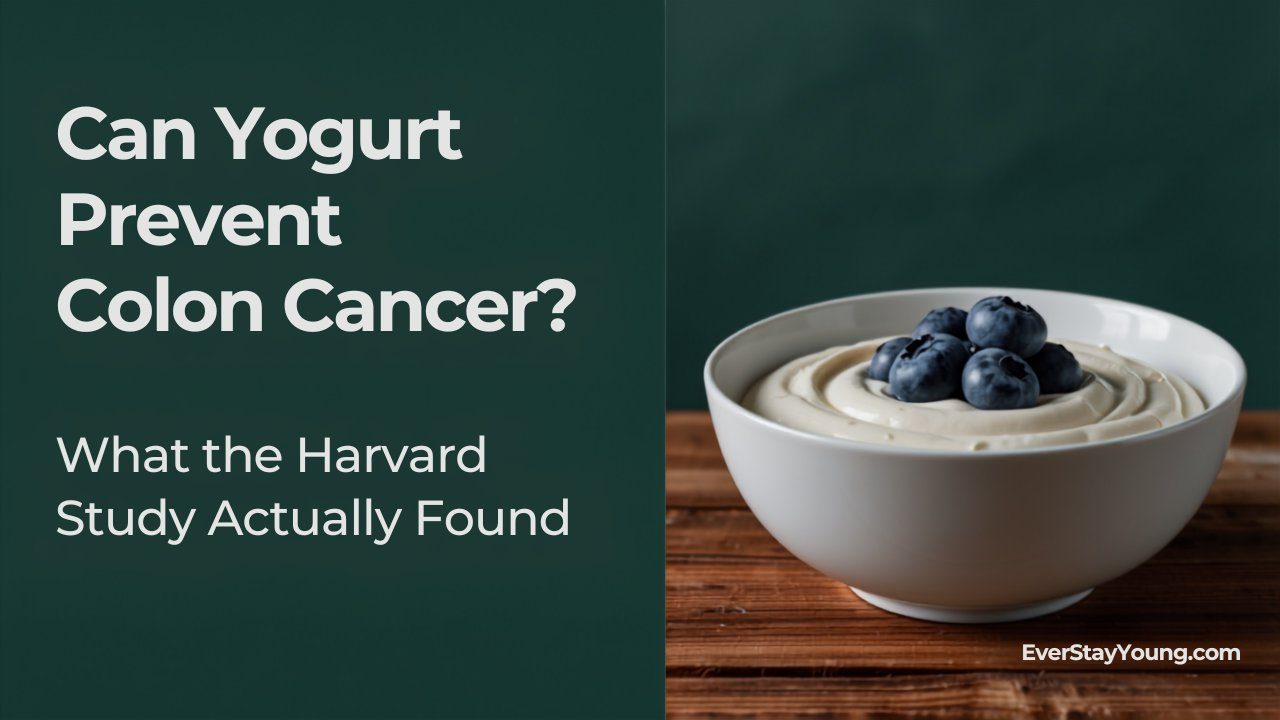
Can Yogurt Prevent Colon Cancer? What the Harvard Study Actually Found
TL;DR: Headlines claimed yogurt prevents colon cancer, but the 2025 Harvard-led study found something more specific: regular yogurt intake was linked to lower risk of proximal colon tumors that tested Bifidobacterium-positive. Not all colorectal cancers. That is a meaningful signal, not a simple prevention story, and the difference matters.
Table of Contents
- The Common Belief: Yogurt Prevents Colon Cancer and Why It Keeps Spreading
- What Did the Harvard Study Actually Measure?
- What Do the Studies Actually Show?
- The Nuance: When Is the Common Belief Partly Right?
- Why Does This Distinction Matter for Your Biological Age?
- What Actually Works: An Evidence-Based Gut Strategy
- FAQ
- Conclusion
- References
The Common Belief: Yogurt Prevents Colon Cancer and Why It Keeps Spreading
When the Harvard T.H. Chan School of Public Health released findings in 2025 linking yogurt consumption to colorectal cancer risk, the headlines wrote themselves.
“Yogurt Could Lower Your Risk of Colon Cancer.” “Eat Yogurt to Fight Cancer.” “Harvard Says Dairy May Protect Against Colorectal Cancer.”
The logic feels sound. Yogurt contains live bacterial cultures. The gut microbiome influences inflammation. Inflammation drives cancer. Therefore, eat yogurt, change your microbiome, lower your cancer risk.
This chain of reasoning is not wrong. It is just missing most of the story.
The 2025 study did find a statistically significant association between yogurt and colorectal cancer. What the headlines rarely explained: that association was limited to a specific anatomical location, a specific tumor characteristic, and held only in observational data that cannot establish cause and effect.
Understanding where that line is drawn matters for making sound dietary decisions, and for understanding what gut microbiome science can and cannot tell us right now.
What Did the Harvard Study Actually Measure?
The primary study: Ugai S et al., “Long-term yogurt intake and colorectal cancer incidence subclassified by Bifidobacterium abundance in tumor,” Gut Microbes 2025;17(1). PMID: 39937126.
| Parameter | Detail |
|---|---|
| Study design | Prospective cohort (observational) |
| Sample size | 132,056 participants |
| Follow-up duration | Over 30 years |
| CRC cases total | 3,079 |
| Tumors with Bifidobacterium data | 1,121 |
| Yogurt exposure | Self-reported via food frequency questionnaire |
| Key finding | Yogurt at 2+ servings/week linked to lower proximal Bifidobacterium-positive CRC incidence |
The researchers tested whether people who ate more yogurt over decades developed colorectal cancer at lower rates, and specifically whether that association differed by tumor location (proximal vs. distal colon, rectum) and by whether the tumor tissue contained detectable Bifidobacterium.
What Do the Studies Actually Show?
| What People Think | What the Data Shows | Evidence Level |
|---|---|---|
| “Yogurt prevents colon cancer” | Yogurt linked to lower risk of ONE subtype: proximal, Bifidobacterium-positive tumors | Observational cohort |
| “The effect is the same throughout the colon” | Association was NOT significant for distal CRC or rectal cancer | Observational cohort |
| “Eating yogurt changes your gut bacteria beneficially” | Mechanism is biologically plausible but not proven causally in humans | Mechanistic hypothesis |
| “This is like taking a probiotic” | Commercial yogurt bacterial strains vary; Bifidobacterium content differs by product | Evidence incomplete |
| “Harvard proved this works” | Researchers found an observational association in 30-year cohort data, not a clinical trial | Prospective cohort |
What “Proximal” Means and Why It Matters for Cancer Biology
The colon has two main anatomical regions. The right side (proximal or ascending colon) and the left side (distal or descending colon, sigmoid) differ in embryological origins, microbial environment, molecular driver mutations, and prognosis at advanced stages. Proximal colorectal cancer, when metastatic, carries worse five-year survival rates than distal disease.
A finding that specifically affects proximal tumors is not just an anatomical footnote. It reflects something real about where in the colon microbial fermentation products like butyrate do their work.
What Is Bifidobacterium and Why Does It Appear in Tumor Tissue?
Bifidobacterium is a genus of bacteria that naturally colonizes the large intestine. It is among the dominant genera in the gut of healthy infants and typically declines with age, westernized diet, and antibiotic exposure. Three mechanisms connect Bifidobacterium to cancer biology:
Butyrate production. Bifidobacterium ferments dietary fiber into short-chain fatty acids including butyrate, the preferred fuel of colonocytes (colon lining cells). Butyrate promotes colonocyte differentiation and has demonstrated anti-proliferative effects in laboratory models of colon cancer.
Immune modulation. Animal studies link Bifidobacterium to enhanced anti-tumor immune responses, including increased CD8+ T cell activity. A connection between gut microbiome composition and response to cancer immunotherapy has been an active research area for over a decade.
Tumor tissue colonization. The 2025 study used a technique to detect Bifidobacterium DNA within archived tumor tissue. Tumors that tested positive for Bifidobacterium were the only ones where the yogurt association reached significance. Tumors without detectable Bifidobacterium showed no meaningful association with yogurt intake. This tumor-subtype specificity is what makes the finding both compelling and appropriately limited.
The Nuance: When Is the Common Belief Partly Right?
The headline version of this story is not fabricated. The observational signal is real. Three decades of follow-up data from over 130,000 people is not trivial. The common belief captures something true: the gut microbiome, dietary patterns, and colorectal cancer risk are connected. That relationship has been replicated across multiple independent cohorts.
The claim that yogurt is worth including in a diet focused on gut health and aging is defensible on current evidence. Not because this one study establishes causation, but because the biological mechanisms are plausible, the food has a well-established safety profile, and the association data leans consistently positive.
The claim that eating yogurt prevents colon cancer is where the evidence does not yet reach.
Why Does This Distinction Matter for Your Biological Age?
Colorectal cancer is the third most common cancer in the United States and a significant cause of premature mortality in adults over 40. Beyond cancer risk specifically, the gut microbiome influences biological aging through mechanisms that extend further. The production of butyrate and other short-chain fatty acids by gut bacteria is linked to systemic inflammation, metabolic health, and epigenetic regulation, which are pathways that determine how fast the body ages at the cellular level.
Microbiome-driven inflammation contributes to what researchers call “inflammaging”: the chronic low-grade inflammatory state that accelerates biological age across multiple organ systems. Supporting a gut environment that hosts Bifidobacterium and produces adequate butyrate is not only a colorectal cancer strategy. It is a plausible intervention in the biology of aging, supported by mechanistic evidence even where clinical causal data is still developing.
What Actually Works: An Evidence-Based Gut Strategy
Increase Dietary Fiber First
Bifidobacterium cannot colonize the gut without adequate substrate. Inulin, pectin, and resistant starch, found in oats, legumes, cooked and cooled potatoes, and unripe bananas, are preferred fermentation fuels. Evidence-based estimates for optimal fiber intake sit at 25 to 38 grams per day, well above what most Western diets provide.
Consume Fermented Foods Consistently
The Harvard finding was for regular yogurt consumption: two or more servings per week, maintained over decades. Not occasional. The microbiome responds to consistent dietary input over time. If you want to specifically support Bifidobacterium strains at consistent doses that food sources alone may not reliably provide, a targeted probiotic is worth considering.
Disclosure: affiliate link. I earn a small commission at no additional cost to you if you purchase through this link.
Support Butyrate Production Directly
Reaching consistent fiber amounts through food alone is difficult for most people following a Western diet. Tributyrin is a more bioavailable form of butyrate than sodium butyrate because it resists absorption in the upper digestive tract and delivers butyrate to the lower colon where it is most relevant.
Disclosure: affiliate link. I earn a small commission at no additional cost to you if you purchase through this link.
Reduce Microbiome Disruptors
Ultra-processed food, chronic antibiotic use, alcohol in excess, and chronic sleep deprivation all reduce Bifidobacterium abundance and short-chain fatty acid production. Supporting the gut microbiome has a ceiling set largely by what you remove from the equation, not just what you add.
Frequently Asked Questions
Does eating yogurt prevent colon cancer?
The 2025 Harvard cohort study found an association between regular yogurt intake (two or more servings per week) and lower risk of one specific subtype: proximal colon tumors that tested Bifidobacterium-positive. No randomized trial has demonstrated that yogurt prevents colorectal cancer. The evidence supports yogurt as part of a gut-healthy diet, not as a standalone preventive intervention.
What is Bifidobacterium and why does it matter?
Bifidobacterium is a genus of gut bacteria that ferments dietary fiber into short-chain fatty acids, including butyrate. Butyrate supports colon cell health and has anti-inflammatory properties in laboratory models. Lower Bifidobacterium abundance has been associated with multiple diseases of aging. Yogurt, kefir, and probiotic supplements are common dietary sources.
Is the right side of the colon different from the left side?
Yes. Proximal (right-sided) and distal (left-sided) colon cancers differ in molecular profile, microbial environment, and prognosis. The Harvard study found the yogurt association only in proximal tumors, which aligns with higher fermentation activity on the right side and greater local exposure to bacterial metabolites like butyrate.
Should I take a probiotic instead of eating yogurt?
Probiotic supplements and yogurt are not interchangeable. Yogurt provides protein and calcium alongside bacteria. Supplements can provide higher, more consistent doses of specific strains. The Harvard study was based on food intake. If your diet is inconsistent, a supplement may provide more reliable Bifidobacterium support, though no probiotic has been tested in colorectal cancer outcome trials.
How much yogurt is enough for gut health?
The Harvard study defined regular consumption as two or more servings per week sustained over decades. One serving is approximately 6 to 8 ounces. Plain yogurt with live cultures is preferable to sweetened varieties, where high sugar content may partially counteract microbiome benefits.
What is butyrate and can I supplement it?
Butyrate is a short-chain fatty acid produced when gut bacteria ferment dietary fiber. It is the primary fuel for colon lining cells and has anti-inflammatory effects locally in the gut. It can be supplemented as tributyrin (more bioavailable) or sodium butyrate, or supported indirectly through increased dietary fiber that feeds butyrate-producing bacteria.
Does this mean I can skip colonoscopy screening?
No. Dietary and microbiome interventions are not substitutes for colorectal cancer screening. Colonoscopy detects precancerous polyps and early-stage disease before symptoms appear. Current guidelines recommend starting at age 45 for average-risk individuals. Gut health strategies and screening are complementary, not alternatives.
Conclusion: The Yogurt Headline Was Half Right
The Harvard 2025 study is a meaningful piece of evidence. Over 130,000 people followed for three decades, 3,079 colorectal cancer cases, with tissue-level data on Bifidobacterium tumor content. This is not a small or poorly designed finding.
What it confirms: there is a biologically coherent association between regular yogurt consumption and lower risk of a specific, anatomically and microbiologically defined cancer subtype. That finding fits a mechanistic story about Bifidobacterium, butyrate, and colon health that has been building in the literature for years.
What it does not confirm: that yogurt prevents colon cancer. Acting on the first claim supports sensible dietary habits. Treating the second claim as established fact leads to skipping screening, neglecting fiber intake, and assuming a single food fills a complex gap.
For adults focused on biological aging, the gut microbiome is worth supporting with consistent strategy: fermented foods, adequate fiber, reduction of microbiome disruptors, and where needed, targeted supplementation. Alongside, not instead of, age-appropriate cancer screening.
Continue reading:
How Chronic Stress Accelerates Your Biological Age and What Safety Signals Can Do About It
What Biological Age Actually Measures and How to Slow It
The Gut-Longevity Connection: What the Microbiome Research Actually Supports
References
- Ugai S et al. Long-term yogurt intake and colorectal cancer incidence subclassified by Bifidobacterium abundance in tumor. Gut Microbes. 2025;17(1). PMID: 39937126. DOI: 10.1080/19490976.2025.2452237
- Liu W et al. Emerging roles for intestinal microbiota in colon cancer. World J Gastroenterol. 2011;17(35):4038-4043. PMID: 22039326.
- O’Keefe SJ. Diet, microorganisms and their metabolites, and colon cancer. Nat Rev Gastroenterol Hepatol. 2016;13(12):691-706. PMID: 27848961.
- Thanikachalam K, Khan G. Colorectal cancer and nutrition. Nutrients. 2019;11(1):164. PMID: 30646512.
- Harvard T.H. Chan School of Public Health. Regular yogurt consumption may reduce colon cancer risk. News release. 2025.