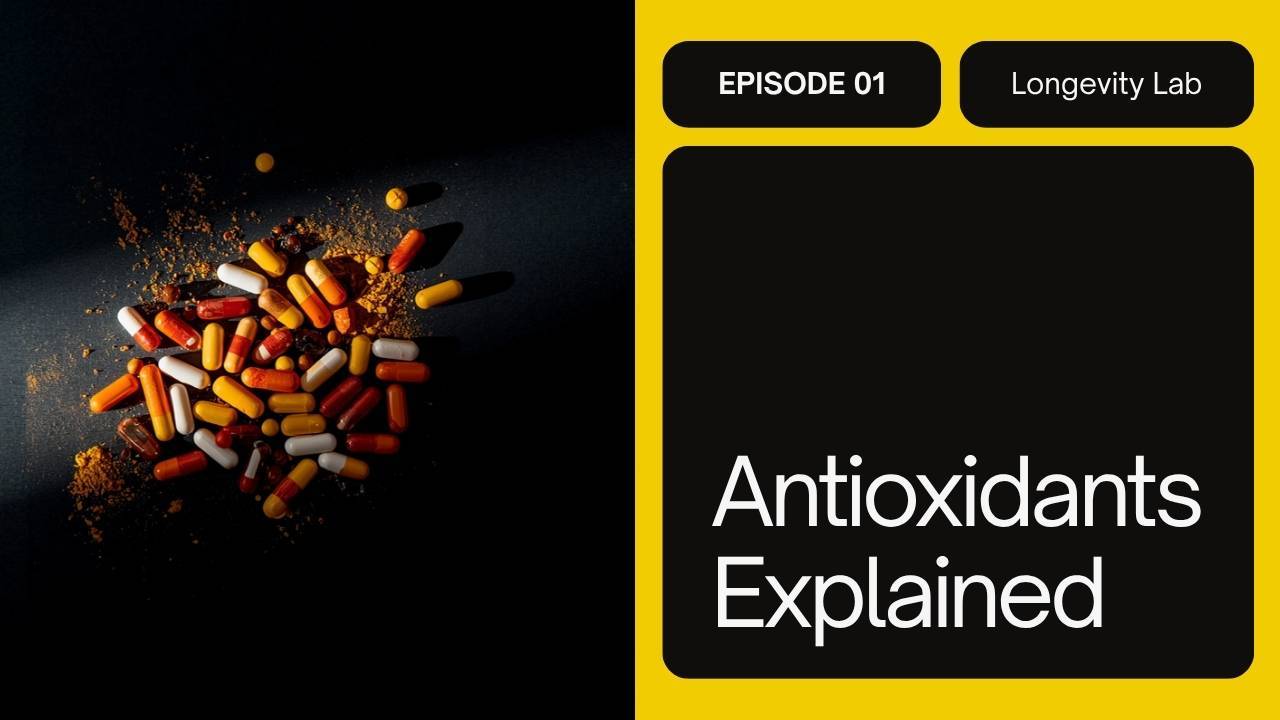
Antioxidant Supplements Slow Aging: What the Science Actually Shows
TL;DR: The idea that antioxidant supplements slow aging by mopping up free radicals is largely wrong — the largest human trials show they increase mortality, not reduce it. What the data actually shows is that reactive oxygen species (ROS) are signaling molecules your body needs, and suppressing them with supplements blocks the very stress-response pathways that drive longevity.
[toc]
The Common Belief (And Why It’s Incomplete)
Walk into any supplement store and you’ll find shelves stacked with vitamin C, vitamin E, beta-carotene, resveratrol, and dozens of blended “antioxidant formulas.” The pitch is always some version of the same story: aging is caused by free radical damage; antioxidants neutralize free radicals; therefore, antioxidants slow aging.
This idea has a respectable scientific pedigree. Denham Harman proposed the free radical theory of aging in 1956. For decades, it was the dominant framework in geroscience. If oxidative damage accumulates in cells over time — damaging DNA, proteins, and lipid membranes — then reducing that damage should slow the aging process. It sounds airtight.
The problem is that when researchers actually tested it in large, rigorous trials, the theory collapsed. Not partially. Substantially.
What the Studies Actually Show
| What People Think | What the Data Shows |
|---|---|
| Antioxidant supplements neutralize harmful free radicals and protect cells | At supplemental doses, they suppress ROS signals that activate longevity pathways (AMPK, Nrf2, PGC-1α) |
| Higher antioxidant intake → longer life | Meta-analysis of 78 RCTs (296,707 participants): beta-carotene +7% mortality, vitamin E +4%, vitamin A +16% (Bjelakovic 2007, PMID 17327526) |
| Beta-carotene protects against cancer | ATBC trial: beta-carotene supplementation increased lung cancer incidence by 18% in male smokers (PMID 8205268) |
| Vitamin E prevents heart disease | SELECT trial: vitamin E supplementation increased prostate cancer risk by 17% vs. placebo (PMID 19066370) |
| Taking antioxidants before exercise protects muscles | Antioxidants blocked exercise-induced insulin sensitivity improvements in healthy humans; non-supplemented group gained, supplemented group did not (Ristow 2009, PMID 19433800) |
| More antioxidants = less oxidative stress = slower aging | Nematode studies: blocking antioxidant genes (superoxide dismutase) often extends lifespan; boosting them shortens it |
The landmark paper is Bjelakovic et al. 2007, published in JAMA. It analyzed 78 randomized controlled trials enrolling 296,707 participants — among the largest systematic evidence syntheses ever done on a nutritional intervention. The conclusion: supplementation with beta-carotene, vitamin A, and vitamin E was associated with statistically significant increases in all-cause mortality. Vitamin C and selenium showed no significant benefit or harm. The 2012 Cochrane update (PMID 22419320) confirmed these findings.
This wasn’t a fluke of one study or one population. It replicated across trials, across countries, and across dose ranges.
The Nuance: When Is the Common Belief Partly Right?
The free radical theory isn’t entirely wrong — it’s incomplete. Oxidative damage does accumulate with age and does contribute to cellular dysfunction. The mistake was assuming that supplementing antioxidants is the right fix.
Here’s the distinction that matters: ROS are not simply byproducts of a broken metabolism. They are messengers. At low-to-moderate concentrations, reactive oxygen species activate transcription factors including Nrf2, NF-κB, PGC-1α, and FOXO — all of which upregulate the body’s own antioxidant defenses, stimulate mitophagy, and trigger stress-resistance programs that actually extend lifespan in model organisms.
This phenomenon has a name: mitohormesis. It describes the paradox that a small dose of oxidative stress leads to better long-term resilience than no stress at all. The classic example is exercise: a hard workout generates significant ROS, which signal the body to build more mitochondria, increase antioxidant enzyme capacity, and improve insulin sensitivity. Ristow’s 2009 PNAS study showed that when you give people high-dose vitamin C and E during a 4-week exercise program, they lose these benefits entirely. The non-supplemented group improved insulin sensitivity; the supplemented group did not.
So the common belief is partly right in one narrow context: people with severe nutritional deficiency (scurvy-level vitamin C, for instance) genuinely benefit from antioxidant repletion. Correcting a deficiency is not the same as optimizing a healthy system by adding more.
Why This Distinction Matters for Your Biological Age
If ROS signals drive the adaptive responses that slow biological aging — and evidence from epigenetic clock studies, mitochondrial biology, and AMPK/FOXO pathway research strongly suggests they do — then chronically suppressing those signals with high-dose supplements may be counterproductive at the cellular level.
The practical implication is significant. Many people in longevity-conscious communities take daily high-dose vitamin C (1,000–3,000 mg), vitamin E (400+ IU), and mixed carotenoid complexes. If Ristow’s exercise data generalizes — and the Bjelakovic mortality data suggests it does — these interventions may be actively working against the ROS-dependent signaling that exercise, fasting, and heat exposure are designed to trigger.
Epigenetic clock studies have not specifically isolated antioxidant supplementation as an independent predictor of biological age acceleration. But the mechanistic evidence is consistent: blunting hormetic ROS signaling should, over time, reduce the expression of stress-resistance and autophagy genes that clock-based measures of biological aging track most closely.
What Actually Works: Evidence-Based Alternative
The evidence points toward a different framework entirely: instead of adding exogenous antioxidants, the goal is to enhance your body’s intrinsic antioxidant response through hormetic stressors — and to choose supplements with fundamentally different mechanisms when supplementation is warranted.
1. Hormetic stressors (amplify endogenous antioxidant capacity):
- Exercise — particularly resistance training and high-intensity intervals. Generates ROS pulses that upregulate superoxide dismutase (SOD), catalase, and glutathione peroxidase. Do not co-ingest high-dose antioxidant supplements on training days.
- Time-restricted eating / intermittent fasting — mild metabolic stress activates AMPK and Nrf2, upregulating endogenous antioxidant systems.
- Sauna — heat stress activates heat shock proteins and Nrf2 pathway, improving mitochondrial efficiency.
2. Food-derived polyphenols (different mechanism — act as signaling molecules, not ROS scavengers at physiological doses):
- Sulforaphane (broccoli sprouts) — activates Nrf2 at low concentrations without broadly suppressing ROS
- Quercetin and fisetin — senolytic activity distinct from generic antioxidant function
- Anthocyanins (berries) — evidence of cardiovascular benefit from food sources
3. Targeted mitochondrial antioxidants — if supplementation is desired, evidence is stronger for compounds that act specifically in the mitochondrial matrix rather than flooding general circulation:
Sports Research Astaxanthin — a marine carotenoid with a distinct safety profile from beta-carotene; crosses into mitochondria; no increased mortality signal in trials at standard doses (4–12 mg/day).
Jarrow Formulas QH-Absorb Ubiquinol — the reduced (active) form of CoQ10; endogenous to the electron transport chain; supports mitochondrial energy production rather than broadly scavenging ROS.
Neither of these is proven to extend human lifespan. But both have mechanistic rationale and safety profiles categorically different from the high-dose vitamin E and beta-carotene supplements shown to increase mortality.
FAQ
If antioxidant supplements can increase mortality, why are they still sold everywhere?
The negative trial data emerged primarily after 2007. Supplement regulation does not require pre-market efficacy or safety trials — products can be sold based on a plausible biological mechanism, which the free radical theory provided for decades. The market moved faster than the science.
Is vitamin C dangerous?
The Bjelakovic meta-analysis found no significant mortality effect from vitamin C (unlike vitamin E and beta-carotene). At doses up to 1,000 mg/day it appears safe for most people. The concern is more about opportunity cost — it doesn’t demonstrably slow aging — and the blunting of hormetic ROS signaling at very high doses in the exercise context.
What about resveratrol? It’s always marketed as an antioxidant.
Resveratrol primarily works as a SIRT1 activator and AMPK activator, not as a conventional antioxidant at physiological concentrations. Its classification as an “antioxidant supplement” is mostly marketing. The human longevity trial data for resveratrol is weak regardless of mechanism.
Does this mean I should stop taking all antioxidants?
Not necessarily. The mortality signal applies specifically to high-dose isolated supplements of vitamin A, E, and beta-carotene. Getting antioxidants from whole foods carries no such signal and is consistently associated with better outcomes. Food-form antioxidants arrive with cofactors, fiber, and polyphenols that change their biological behavior entirely.
What is mitohormesis and how do I trigger it?
Mitohormesis is the process by which a transient, moderate increase in mitochondrial ROS triggers a compensatory upregulation of antioxidant enzymes and stress-resistance pathways. The most reliable way to trigger it: vigorous exercise, heat (sauna), cold exposure, and caloric restriction. All without co-ingesting high-dose antioxidant supplements in the same window.
Are there any antioxidant supplements with good longevity evidence?
The strongest signal is for mitochondria-targeted compounds. MitoQ (mitoquinone) extended lifespan in C. elegans and improved vascular function in a human RCT. Astaxanthin has favorable safety data and crosses into mitochondria. Neither has human longevity RCT data yet.
Conclusion
The antioxidant-aging hypothesis is one of the most compelling ideas in geroscience that didn’t survive rigorous testing. The largest meta-analyses show that the supplements most heavily marketed for aging — vitamin E, beta-carotene, vitamin A — are associated with higher mortality, not lower.
The more current understanding is that aging is not simply accumulated oxidative damage waiting to be mopped up. ROS are integral to cellular signaling. Suppressing them with high-dose supplements disrupts the hormetic stress-response pathways — mitophagy, AMPK activation, endogenous antioxidant upregulation — that research consistently links to slower biological aging.
The practical strategy isn’t to add antioxidant supplements. It’s to use exercise, fasting, and thermal stress to trigger the body’s own antioxidant response — and to choose food-derived polyphenols and targeted mitochondrial compounds when supplementation is warranted.
Related reading on EverStayYoung:
- Spermidine, Autophagy, and Immune Aging: The Protocol
- Alpha-Ketoglutarate and Aging: What the Evidence Shows
- NAD+ and NMN Supplementation: The Evidence Breakdown
References
- Bjelakovic G, et al. “Mortality in Randomized Trials of Antioxidant Supplements for Primary and Secondary Prevention.” JAMA. 2007. PMID 17327526
- Bjelakovic G, et al. “Antioxidant supplements for prevention of mortality in healthy participants and patients with various diseases.” Cochrane Database Syst Rev. 2012. PMID 22419320
- The Alpha-Tocopherol, Beta-Carotene Cancer Prevention Study Group. “The effect of vitamin E and beta carotene on the incidence of lung cancer.” N Engl J Med. 1994. PMID 8127329
- Lippman SM, et al. “Effect of Selenium and Vitamin E on Risk of Prostate Cancer.” JAMA. 2009. PMID 19066370
- Ristow M, et al. “Antioxidants prevent health-promoting effects of physical exercise in humans.” PNAS. 2009. PMID 19433800
- Ristow M, Schmeisser K. “Mitohormesis: Promoting Health and Lifespan by Increased Levels of Reactive Oxygen Species.” Free Radic Biol Med. 2011. PMID 21619928
- Harman D. “Aging: a theory based on free radical and radiation chemistry.” J Gerontol. 1956. PMID 13332224