Can Wall Squats Lower Blood Pressure? An Isometric Protocol
TL;DR: Yes, for many adults. In a 2023 network meta-analysis of 270 randomised trials (15,827 participants), isometric exercise lowered resting blood pressure by 8.24/4.00 mm Hg, the largest effect of any exercise type, and the wall squat ranked best for systolic pressure. The typical protocol is 4 holds of 2 minutes, 3 times a week, which is about 12 minutes of holding per session. It adds to aerobic exercise rather than replacing it, and if your blood pressure is uncontrolled or you have heart disease, check with your clinician first.
Table of Contents
- Why Does the Standard Exercise Advice Fall Short for Blood Pressure?
- What Does the Evidence-Based Isometric Protocol Look Like?
- Step 1: How Do You Find Your Wall Squat Height?
- Step 2: How Should You Run the 4 x 2 Minute Session?
- Step 3: How Do You Progress and Track Results?
- Is Handgrip Training a Good Alternative?
- Who Is This Protocol For (and Who Should Check First)?
- How Long Before You See Results?
- FAQ
- Conclusion
- References
Most people who are told to exercise for their blood pressure hear one thing: walk more, or do some cardio. That advice is correct, but it leaves out the exercise type that produced the biggest average drop in resting blood pressure in the largest analysis of exercise trials so far. It is also the one that looks the least like exercise: holding still.
This article walks through what the research shows about isometric training, mainly the wall squat and the handgrip, and turns the published study protocols into a routine you can do at home. Every number here comes from the original papers, and I will flag where the evidence is thinner than the headlines suggest.
Why Does the Standard Exercise Advice Fall Short for Blood Pressure?
Blood pressure guidelines have recommended aerobic exercise for decades, and for good reason. The 2025 American Heart Association and American College of Cardiology hypertension guideline lists aerobic exercise of 90 to 150 minutes per week with an expected systolic reduction of about 4 to 8 mm Hg. The problem is that the classic message stops there, and many people never hear that static exercise also works.
In 2023, Edwards and colleagues published a large pairwise and network meta-analysis in the British Journal of Sports Medicine. They pooled 270 randomised controlled trials published between 1990 and February 2023, with 15,827 participants in total. Every trial ran for at least 2 weeks and had a non-exercise control group.
All the main exercise types lowered resting blood pressure. But the size of the effect differed:
| Exercise type | Average systolic reduction (mm Hg) | Average diastolic reduction (mm Hg) | SUCRA ranking for systolic |
|---|---|---|---|
| Isometric exercise training | 8.24 | 4.00 | 98.3% |
| Combined aerobic and resistance | 6.04 | 2.54 | 75.7% |
| Dynamic resistance training | 4.55 | 3.04 | 46.1% |
| Aerobic exercise training | 4.49 | 2.53 | 40.5% |
| High-intensity interval training | 4.08 | 2.50 | 39.4% |
SUCRA is a ranking score from 0 to 100% that estimates how likely a treatment is to be the most effective. Isometric training sat at 98.3% for systolic pressure. When the authors split the isometric category into sub-types, the isometric wall squat ranked as the most effective sub-mode for systolic pressure (SUCRA 90.4%), while running ranked best for diastolic pressure.
Two caveats matter. First, all exercise types produced substantially larger reductions in people who already had high blood pressure than in people with normal readings, so your own result depends on where you start. Second, isometric trials tend to be smaller than aerobic trials, so the estimate is less precise. The authors declared no competing interests, and no funding was used to prepare the paper.
The 2025 AHA/ACC guideline itself now lists static or isometric resistance training next to aerobic and dynamic resistance exercise as particularly effective for lowering blood pressure in adults with or without hypertension, with an expected systolic reduction of 5 to 10 mm Hg.
What Does the Evidence-Based Isometric Protocol Look Like?
The isometric trials converge on a surprisingly consistent dose. Edwards and colleagues describe it directly: programmes commonly use 4 contractions of 2 minutes, separated by 1 to 4 minutes of rest, performed three times a week. The AHA/ACC guideline table gives the same structure for handgrip: 4 x 2 minutes at 30% to 40% of maximum voluntary contraction, 1 minute of rest, 3 sessions per week.
| Step | Action | Evidence level | Time required |
|---|---|---|---|
| 1 | Find a wall squat height that feels hard but sustainable (target effort about 4 out of 10 at first) | Pilot RCT (Lea 2024) | One 10 to 15 minute setup session |
| 2 | Do 4 holds of 2 minutes with 2 minutes rest, breathing normally | Network meta-analysis of 270 RCTs (Edwards 2023), AHA/ACC 2025 guideline | About 14 to 20 minutes, 3 times a week |
| 3 | Adjust height so effort climbs across the 4 holds, and track home blood pressure weekly | Pilot RCT (Lea 2024) | 5 minutes per week for measurements |
You do not need a gym. You need a wall, a timer, a pencil or a piece of tape, and ideally a validated upper-arm blood pressure monitor so you can see whether it is working for you.
Step 1: How Do You Find Your Wall Squat Height?
The hard part of isometric training has always been intensity. In laboratory studies, wall squat height is usually set so that heart rate reaches 95% of the peak reached in a maximal incremental isometric test, which needs equipment most people do not have.
A 2024 pilot trial by Lea, O’Driscoll and colleagues, published in the European Journal of Applied Physiology, tested a simpler way: rating of perceived exertion (RPE) on a 0 to 10 scale. Thirty adults aged 18 to 65 with normal or slightly raised blood pressure (24 of them pre-hypertensive men) were randomised to a control group, a heart-rate-guided wall squat group, or an RPE-guided wall squat group.
Here is how the RPE group found its height, translated into home steps:
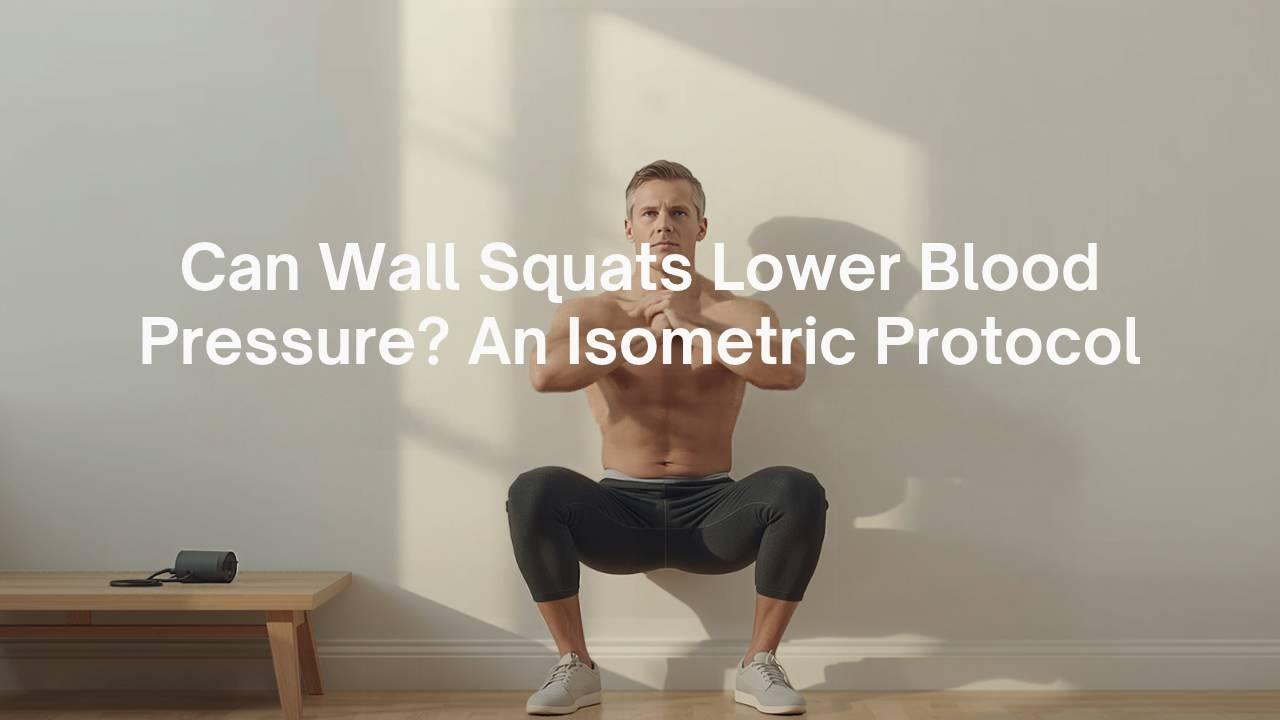
- Stand with your back flat against a wall and walk your feet forward.
- Slide down until you reach a height you think will feel like about 4 out of 10 effort after 2 minutes. Keep your lower legs vertical, so your knees stay above your ankles.
- Mark the lowest point where your back touches the wall with a small piece of tape or putty.
- Hold for 2 minutes, then rate the effort from 0 (nothing) to 10 (maximal).
- If the effort was clearly too easy or too hard, move the marker 1 or 2 cm and try again on the next bout.
Step 2: How Should You Run the 4 x 2 Minute Session?
In the Lea trial, each session was 4 bouts of 2 minutes, separated by 2 minutes of rest. During setup, the target effort rose across the four bouts: about 4 out of 10 at the end of bout 1, 5.5 at bout 2, 7 at bout 3 and 8.5 at bout 4. That rising pattern is normal. The same height gets harder as your legs fatigue, which is the point.
- Warm up with 3 to 5 minutes of easy walking or marching in place.
- Hold 1: 2 minutes at your marked height. Breathe normally the whole time. The researchers told participants this specifically to avoid the Valsalva manoeuvre (straining with a held breath), which spikes blood pressure.
- Rest: 2 minutes standing or walking.
- Holds 2 to 4: repeat. By the fourth hold your effort should be high, around 8 or 9 out of 10, but you should still be able to finish with good form.
- Frequency: 3 sessions per week, with about 48 hours between sessions, as in the study (12 sessions over 4 weeks).
Results in this small trial were large. After 4 weeks, resting seated systolic pressure fell by 9 mm Hg on average in the RPE group and 14 mm Hg in the heart-rate group, and 24-hour ambulatory systolic pressure fell by 8 and 10 mm Hg. Every participant in both intervention groups reached at least a 5 mm Hg drop in systolic and/or diastolic pressure, which the authors used as the minimum clinically important difference. The two prescription methods were not statistically different. The authors declared no conflicts of interest.
Keep the scale of this study in mind: 30 people, mostly men, for 4 weeks. It shows that a home RPE-guided method is feasible and in the same range as lab-guided training. It does not prove you will see a 9 mm Hg drop. The 270-trial meta-analysis is the better guide to the average effect.
Step 3: How Do You Progress and Track Results?
Blood pressure varies from day to day, so a single reading after a week tells you little. Measure the same way each time: seated, after 5 minutes of quiet rest, arm supported at heart level, two readings a minute apart, at the same time of day. Do it on non-training days or before a session, not straight after one.
Disclosure: affiliate link. I earn a small commission at no additional cost to you if you purchase through this link.
As the weeks pass, the same height will start to feel easier. When the fourth hold no longer reaches roughly 8 out of 10 effort, lower your marker by 1 or 2 cm. That is how the RPE method keeps the stimulus constant without a heart rate monitor.
Is Handgrip Training a Good Alternative?
If wall squats are hard on your knees, handgrip training is the most studied alternative and the version named in the AHA/ACC guideline table. A small randomised trial by Okamoto and colleagues in Aging Clinical and Experimental Research (2020) followed 22 non-medicated East Asian adults with a mean age of 65. The handgrip group did 4 two-minute contractions with one hand at 30% of maximal strength, with 1 minute of rest, 5 days a week for 8 weeks.
Compared with baseline, central systolic pressure, brachial systolic and diastolic pressure, and a measure of arterial wave reflection all fell significantly in the handgrip group, with no changes in the control group. The study was small, and 30% intensity needs a way to measure your grip strength, which is why lab trials used dynamometers.
Disclosure: affiliate link. I earn a small commission at no additional cost to you if you purchase through this link.
In the Edwards network analysis, the wall squat ranked above handgrip and isometric leg extension for systolic pressure, so if your joints allow it, the wall squat is the first choice. Handgrip is a sensible option if they do not.
Who Is This Protocol For (and Who Should Check First)?
The trials behind this protocol mostly included adults with normal, high-normal or high blood pressure who were otherwise healthy. Isometric holds raise blood pressure temporarily while you do them, so a few groups should talk to a clinician before starting:
- People with uncontrolled or very high blood pressure.
- Anyone with known heart disease, heart failure, aortic aneurysm, or a recent heart attack or stroke.
- People with knee problems who cannot hold a wall squat without pain (handgrip may be an option).
- Anyone on blood pressure medication: keep taking it, and tell your doctor, because readings may drop and your dose may need review.
This protocol is not a replacement for medication or for aerobic activity. The AHA/ACC guideline lists aerobic exercise, dynamic resistance and isometric training as separate options, and being active overall has benefits that go well beyond blood pressure. If you want the step-count side of that story, see what the data says about 10,000 steps a day.
How Long Before You See Results?
In the meta-analysis, every included trial lasted at least 2 weeks, and isometric programmes typically ran for several weeks. The Lea pilot measured clear changes after 4 weeks (12 sessions), and the Okamoto handgrip trial ran for 8 weeks. A fair expectation is that if this works for you, your home readings should start to trend down within 4 to 8 weeks of consistent training, 3 times a week. Like any exercise effect, it fades if you stop.
Blood pressure matters well beyond the heart. In a two-year trial of exercise and intensive blood pressure lowering, lower blood pressure plus exercise did not translate into better memory scores, which is a reminder that lowering a number and protecting a specific outcome are not the same thing.
FAQ
Is isometric exercise better than cardio for blood pressure?
On average it produced the biggest drop in a 270-trial network meta-analysis: 8.24/4.00 mm Hg versus 4.49/2.53 for aerobic training. It works best as an addition to aerobic activity, which has broader health benefits.
How long should I hold a wall squat to lower blood pressure?
Studies use 4 holds of 2 minutes, with 1 to 4 minutes of rest between them, 3 times a week. The Lea home trial used 2-minute rests and 48 hours between sessions.
How low should I squat?
Low enough that the first 2-minute hold feels like about 4 out of 10 effort and the fourth reaches about 8 to 9. Keep your shins vertical.
Is it safe to do wall squats with high blood pressure?
Blood pressure rises during the hold. In trials, participants were screened and told to breathe normally. If your pressure is uncontrolled or you have heart disease, get medical clearance first.
Can I stop my blood pressure medication if this works?
No. Keep taking prescribed medication and share your home readings with your doctor, who can decide whether any change is appropriate.
Does handgrip training work as well as wall squats?
Handgrip lowers blood pressure in trials and is the version in the 2025 AHA/ACC guideline table, but the wall squat ranked higher for systolic pressure in the Edwards analysis.
Conclusion
Isometric training is the most underused tool in blood pressure exercise advice. The largest analysis to date puts it at the top for average effect, the 2025 US guideline now names it, and the wall squat version needs nothing but a wall and 12 minutes of holding three times a week. Start with an honest effort rating, breathe normally, measure at home, and keep your aerobic activity going. For more on the other levers, read 5 proven strategies to lower blood pressure naturally.
If you want the full system behind decisions like this one, including the biomarkers I track, I wrote it all down in The MVHK Protocol.
References
- Edwards JJ, Deenmamode AHP, Griffiths M, Arnold O, Cooper NJ, Wiles JD, O’Driscoll JM. Exercise training and resting blood pressure: a large-scale pairwise and network meta-analysis of randomised controlled trials. Br J Sports Med. 2023;57(20):1317-1326. PMID: 37491419.
- Lea JWD, O’Driscoll JM, et al. The implementation of a home-based isometric wall squat intervention using ratings of perceived exertion to select and control exercise intensity: a pilot study in normotensive and pre-hypertensive adults. Eur J Appl Physiol. 2024;124(1):281-293. PMID: 37458822.
- Okamoto T, et al. Isometric handgrip training reduces blood pressure and wave reflections in East Asian, non-medicated, middle-aged and older adults: a randomized control trial. Aging Clin Exp Res. 2020;32(8):1485-1491. PMID: 31463925.
- 2025 AHA/ACC/AANP/AAPA/ABC/ACCP/ACPM/AGS/AMA/ASPC/NMA/PCNA/SGIM Guideline for the Prevention, Detection, Evaluation, and Management of High Blood Pressure in Adults. J Am Coll Cardiol. 2025;86(18):1567-1678. PMID: 40815242.