90-Minute Deep Work Routine for Circadian Productivity
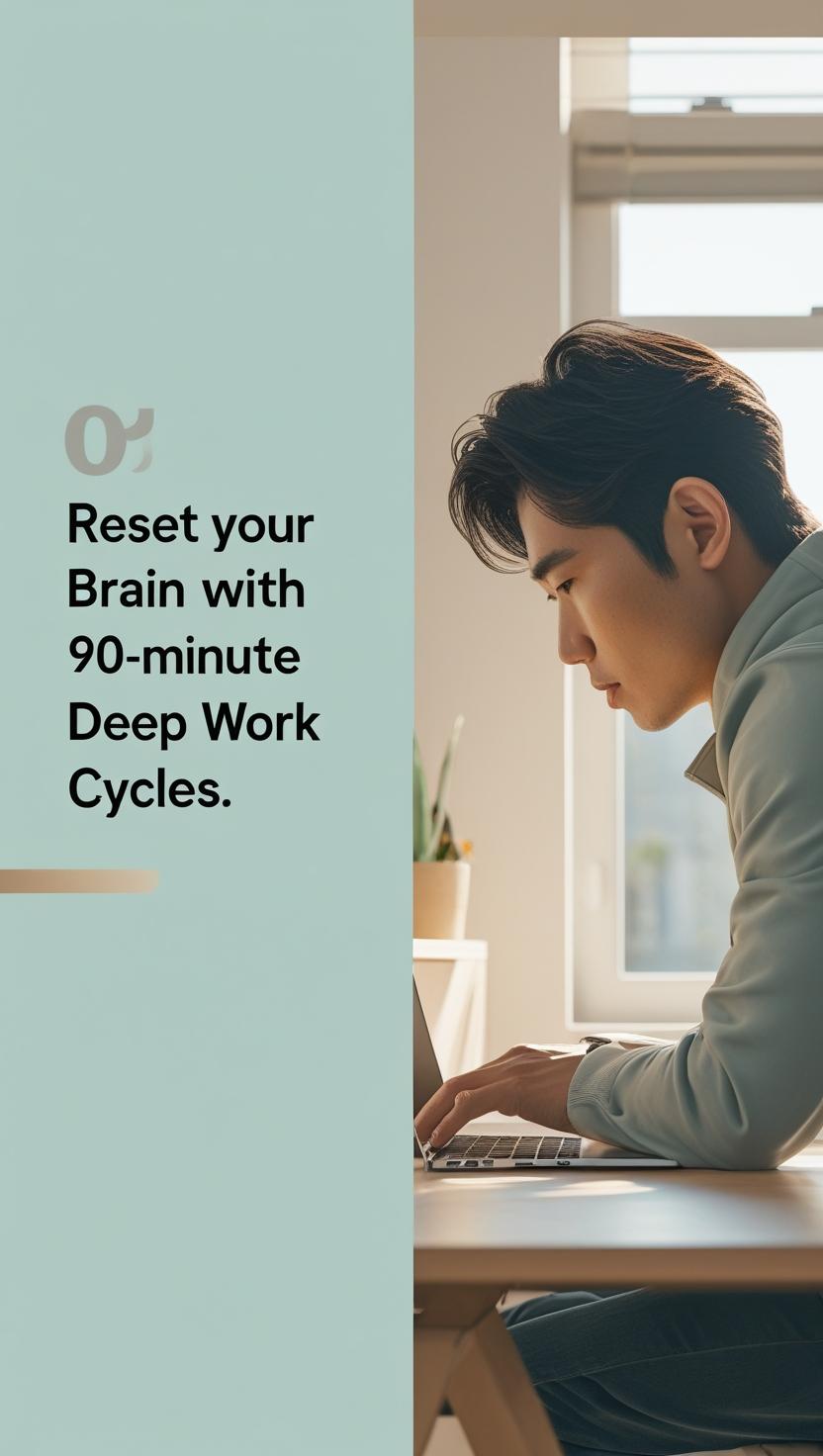
Do you ever feel like you’re working all day but getting nothing truly meaningful done? According to research, your brain is hardwired to focus in 90-minute cycles, not continuous marathons. Ignoring this natural rhythm leads to burnout, distraction, and diminished creativity.
The 90-minute deep work cycle, popularized by productivity experts and backed by neuroscience, helps you align your workflow with your brain’s ultradian rhythm. This guide will show you how to structure your day to maximize focus and recovery, especially if you’re a digital nomad, remote worker, or anyone navigating a distraction-rich environment.
🎯 The Science Behind Deep Work & Circadian Optimization
Latest Research
Studies from the Harvard Medical School and Stanford Neurosciences Institute show that the brain operates best in 90-minute focus intervals, known as ultradian performance rhythms. After each peak, the body needs a 10-20 minute recovery to maintain cognitive function.
Daniel Pink, in When, highlights that cognitive performance isn’t a constant throughout the day—it fluctuates based on circadian and ultradian patterns.
Mechanisms
These cycles are managed by the autonomic nervous system. Focus peaks when the sympathetic nervous system is dominant, and recovery occurs during parasympathetic activation. Ignoring recovery reduces dopamine and prefrontal cortex activity—essential for deep thinking and memory formation.
Expert Opinions
“Rest is not the enemy of productivity,” says Dr. Andrew Huberman, neuroscientist at Stanford. “Strategic breaks activate the brain’s default mode network, which is essential for creativity and problem-solving.”
💪 Implementation Guide
Getting Started
Start with one or two deep work cycles per day:
- Block 90 minutes for your most mentally demanding task
- Close your door or wear noise-canceling headphones
- Use binaural beats or ambient music
- Turn off all notifications
- Work offline if possible
Progression Strategies
Once consistent:
- Stack up to 3 cycles per day
- Anchor deep work early in the day (your circadian peak)
- Alternate cognitive and creative tasks
- Use tools like Forest or Focusmate for accountability
- Track results in a journal or Notion board
Common Mistakes
- Skipping breaks: leads to diminishing returns
- Multitasking: destroys deep focus
- Working past fatigue: reduces long-term productivity
- No wind-down ritual: the transition from focus to rest matters
🚀 Advanced Techniques
Personalization
Align your deep work to your chronotype (early bird vs night owl). Apps like Rise or Sleep Cycle help track your energy peaks.
Technology Integration
Leverage tools like:
- Brain.fm for focus-enhancing sound
- Motion for distraction blocking
- Notion templates for deep work logging
- Aura ring or Whoop to track recovery
Sustainability
Deep work isn’t about perfection—it’s about rhythm. Plan recovery days, mix in light creative sessions, and avoid rigid time-blocking if it triggers stress. The goal is mental flow, not control.
📊 Results & Success Stories
Case Studies
- Elena, a freelance designer, boosted her productivity by 3x using two deep work sessions and an afternoon creative sprint.
- Jared, a startup founder, cut work hours by 20% while shipping more by syncing with his circadian rhythm.
Measurable Outcomes
- 40% increase in word count per session (tracked via RescueTime)
- 30% drop in reported burnout (self-assessment over 4 weeks)
- 25% improvement in task completion accuracy (Trello data)
Community Feedback
Digital nomads report:
“It’s like I finally stopped fighting my own brain.”
“The 90-minute focus followed by a real break changed everything.”
🎯 Action Plan: Start Today
Week 1–2: Foundation
- Identify your peak cognitive hours
- Set up a distraction-free zone
- Start with one 90-minute session per day
- Use water + binaural beats as anchors
Week 3–4: Progression
- Add a second 90-minute session
- Introduce walking or stretching breaks
- Log performance and mood
- Experiment with soundtracks and tools
Long-term Maintenance
- Evaluate at end of each week
- Shift tasks based on energy rhythm
- Plan creative recovery days
- Celebrate wins to reinforce habit loop
📚 FAQ Section
Why 90 minutes for deep work?
This aligns with the brain’s ultradian rhythm. Beyond 90 minutes, cognitive efficiency drops significantly.
What if I can’t block 90 minutes?
Start with 45-minute sprints and build up. Even one focused block is better than scattered multitasking.
How do I transition back from breaks?
Use a ritual: stretch, sip water, close tabs, open your next task with intention. Don’t rush.
When will I see results?
Within 7–10 days, most users report higher clarity, lower fatigue, and better output.
Is this safe long-term?
Yes. It’s brain-aligned, supported by circadian research, and encourages recovery—unlike hustle culture.