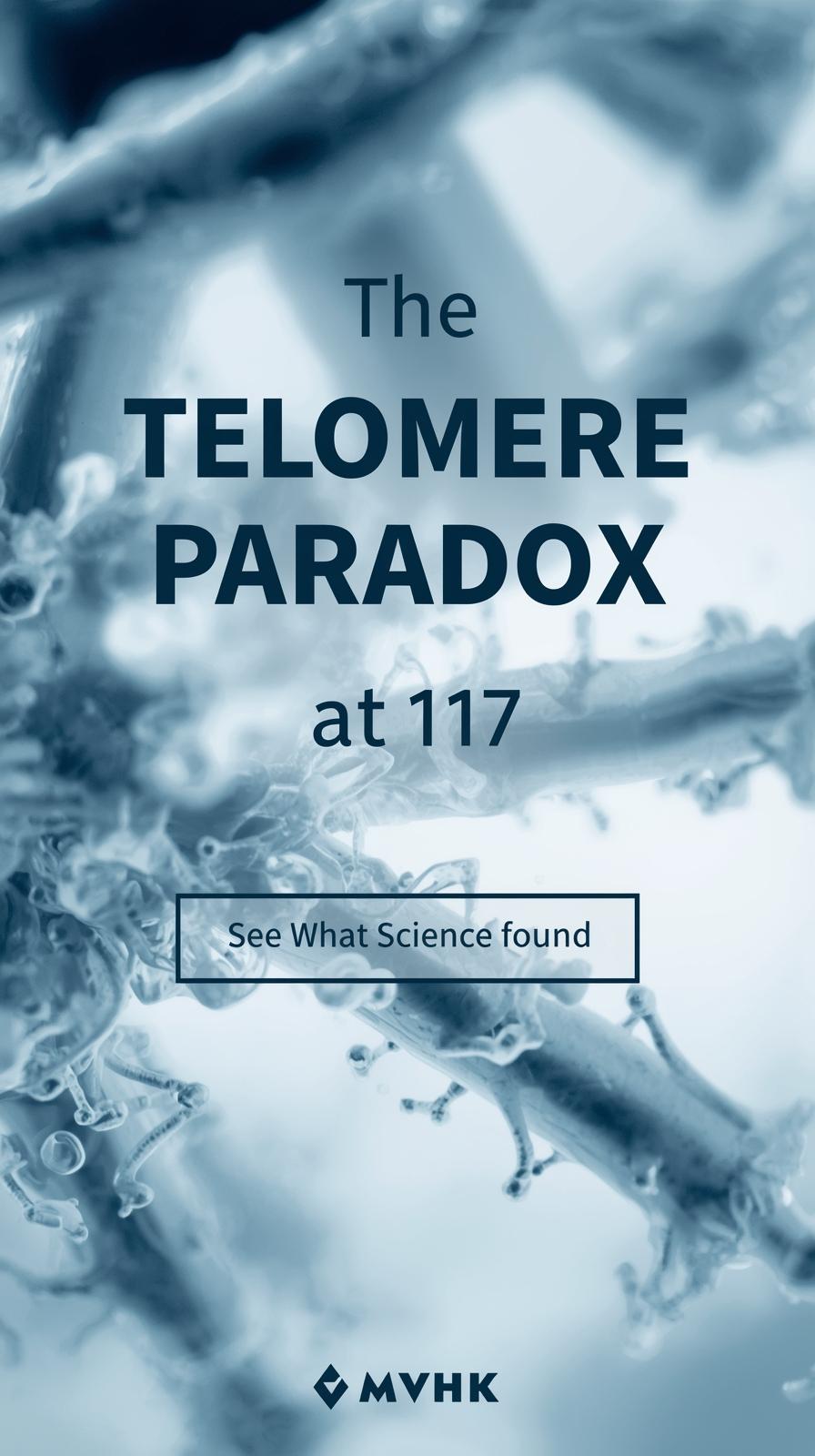
Telomere Paradox in a 117-Year-Old: What the Science Actually Found
💡 Key Takeaways
- A 117-year-old woman showed extremely short telomeres yet no cancer.
- Her biology was marked by low inflammation and strong cardiometabolic health.
- Telomere length may not be a reliable longevity biomarker in very late aging.
- The study challenges telomerase-centered anti-aging strategies.
A recent case analysis published in Cell Reports Medicine examined one of the oldest documented humans — a 117-year-old supercentenarian. The assumption in longevity science has long been simple: longer telomeres equal better aging outcomes. This study complicates that narrative.
Despite having extremely short telomeres — typically associated with higher mortality and cancer risk — she showed no cancer and preserved biological function. More importantly, her cellular biology appeared decades younger than her chronological age.
This is not a lifestyle miracle story. It is a mechanistic disruption of a telomere-centric aging model — with major implications for inflammation control, genomic stability, and cancer risk management.
What Is the Science Behind the Telomere Paradox?
The study directly analyzed cellular, genetic, inflammatory, and microbiome markers in a 117-year-old woman and compared them to younger cohorts.
1️⃣ Biological Age vs Chronological Age
Evidence-supported:
Her epigenetic and cellular markers suggested a biological age decades younger than 117.
2️⃣ Very Low Chronic Inflammation
Evidence-supported:
Markers of systemic inflammation were remarkably low. This strongly relates to suppression of “inflammaging,” a chronic inflammatory state linked to cardiovascular disease, neurodegeneration, and metabolic decline.
(Source direction: Nature Aging, Lancet Healthy Longevity)
Low inflammation likely supported:
- Mitochondrial preservation
- Reduced endothelial damage
- Lower immune exhaustion
3️⃣ Excellent Cardiovascular Profile
Evidence-supported:
Her lipid metabolism and cardiovascular biomarkers were unusually favorable for extreme age.
This aligns with long-term data from NEJM and The Lancet showing cardiovascular resilience as one of the strongest survival predictors past 100.
4️⃣ Strong Immune System
Evidence-supported:
Her immune profile suggested preserved adaptive immune function.
This contradicts typical immunosenescence models described in Nature Reviews Immunology.
5️⃣ Youthful Gut Microbiome
Evidence-supported (associative):
Higher levels of bifidobacteria — commonly reduced in aging — were detected.
However, whether this was causal remains unknown.
The Telomere Shock
She had extremely short telomeres.
Under conventional models:
- Short telomeres → higher mortality
- Short telomeres → increased cancer risk
Yet:
- No cancer
- Preserved function
Hypothesis-supported:
Researchers proposed that limited telomere length may have restricted excessive cellular proliferation, reducing cancer risk.
This directly challenges the assumption that telomere elongation is always beneficial.
Studies in Cell and Nature show telomerase activation can increase cancer risk if proliferation control fails.
The key insight: longevity may depend more on proliferation control than on cellular growth enhancement.
How Do You Apply This Insight Correctly?
You do not try to shorten your telomeres.
Instead, you target the upstream mechanisms that made her biology resilient.
Step 1: Reduce Chronic Inflammation (Weeks 1–2)
Focus on:
- Sleep regularity
- Insulin sensitivity
- Resistance training
- Omega-3 optimization
Inflammation control preserves mitochondrial efficiency and lowers DNA damage.
Step 2: Improve Cardiometabolic Profile (Weeks 2–3)
Target:
- ApoB reduction
- Triglyceride control
- VO₂max improvement
Cardiovascular resilience is consistently predictive of survival past 90.
Step 3: Support Immune Robustness (Weeks 3–4)
- Adequate protein (muscle preservation)
- Zinc sufficiency
- Resistance exercise
Step 4: Support Microbiome Stability (Week 4 onward)
- Fermented foods
- Diverse fiber intake
- Avoid unnecessary antibiotics
Important:
This study does NOT support telomere activation supplements as longevity tools.
What Advanced Strategies Improve Results?
1️⃣ Biomarker Personalization
Track:
- hs-CRP
- ApoB
- Fasting insulin
- VO₂max
- Homocysteine
2️⃣ Avoid “Pro-Growth” Over-Optimization
Aggressive mTOR stimulation or unchecked telomerase activation may increase long-term cancer risk.
3️⃣ Focus on Genomic Stability
Emerging research in Cell Reports Medicine and Nature Aging suggests DNA repair integrity may be more important than telomere length alone.
What Results Can You Realistically Expect?
You will not become a supercentenarian from one biomarker tweak.
What you can expect:
- Lower inflammation within weeks
- Improved insulin sensitivity in 2–4 weeks
- Measurable VO₂max gains in 6–8 weeks
What you should NOT expect:
- Telomere reversal miracles
- Cancer immunity from supplements
- Guaranteed lifespan extension
This was an N=1 case. The authors explicitly call for larger cohorts.
4-Week Practical Action Plan
Week 1
- Fix sleep timing
- Measure hs-CRP
Week 2
- Begin structured resistance training (3x weekly)
- Add omega-3 (if deficient)
Week 3
- Test ApoB and fasting insulin
- Add VO₂max interval session
Week 4
- Increase fiber diversity to 30+ plant types weekly
- Add fermented foods
Goal: lower inflammation, improve metabolic flexibility, preserve muscle mass.
Frequently Asked Questions
Is telomere length useless as a biomarker?
Not useless — but unreliable in very late aging. It may not predict outcomes past extreme age.
Should we activate telomerase?
Current evidence suggests caution. Telomerase can increase proliferative capacity and possibly cancer risk.
Did her microbiome cause her longevity?
There is no causal proof. It was an associative finding.
Does this mean aging is separate from disease?
The study supports the idea that biological aging and pathology can be partially decoupled.
Is this actionable for lifestyle?
Indirectly. The takeaway is inflammation control and genomic stability — not telomere manipulation.
References
- Cell Reports Medicine (Supercentenarian case analysis)
- Nature Aging
- The Lancet Healthy Longevity
- NEJM Cardiovascular Longevity Data
- Nature Reviews Immunology