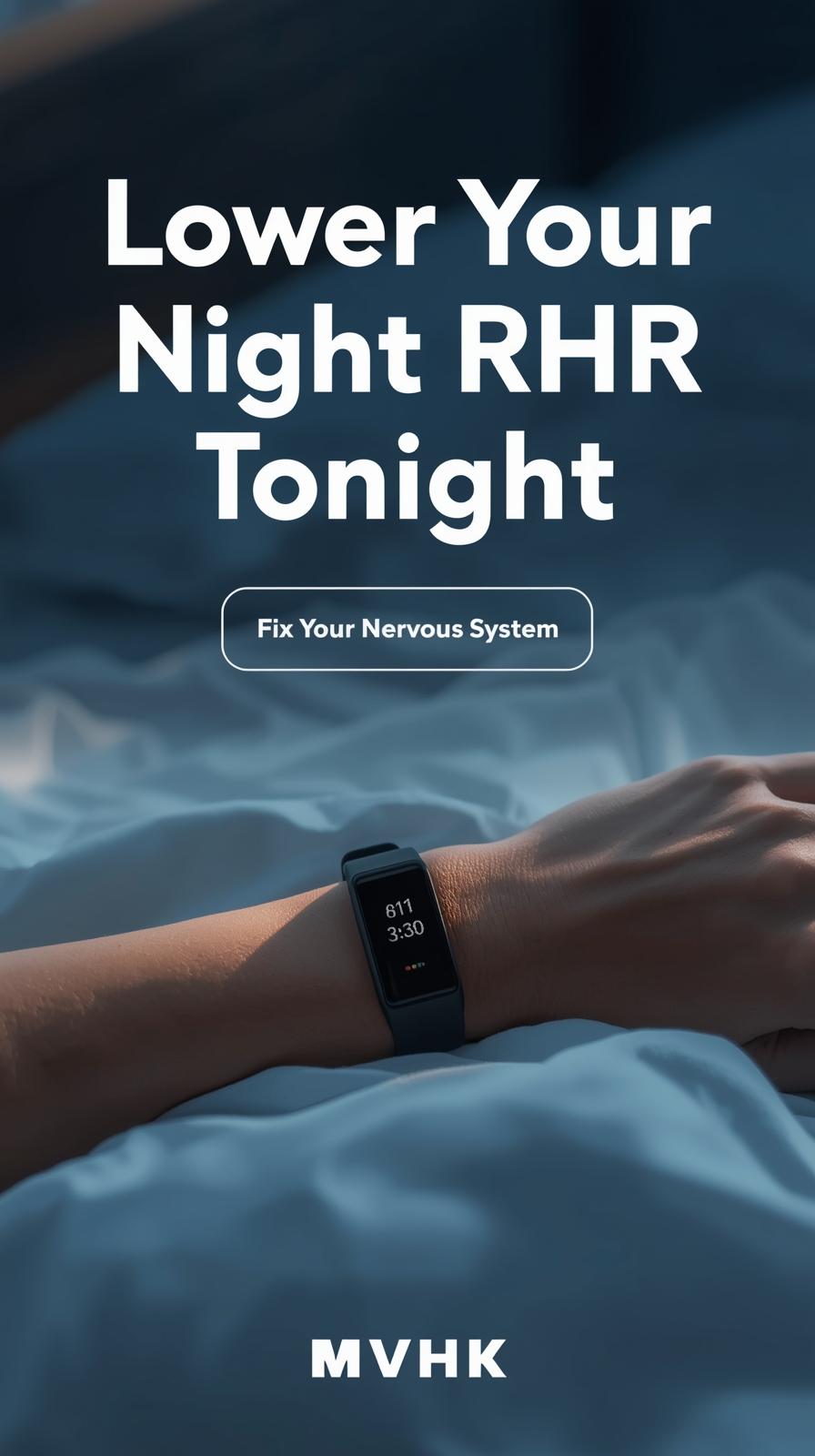
How to Lower Resting Heart Rate Before Bed for Longevity
💡 Key Takeaways
- Nighttime resting heart rate (RHR) reflects autonomic nervous system balance
- Lower RHR before bed signals stronger parasympathetic activation
- Social media and late meals elevate sympathetic tone and glucose levels
- Strategic evening habits can measurably lower RHR within weeks
Introduction
Resting heart rate is one of the most predictive biomarkers available on a wearable device.
Elevated resting heart rate correlates with increased cardiovascular mortality, systemic inflammation, and reduced lifespan (Evidence-supported: PubMed, NEJM population cohorts). Yet most people treat it as a passive metric rather than a lever.
If your heart rate drops significantly during sleep onset, that’s a sign your nervous system has shifted into parasympathetic dominance — the biological state required for tissue repair, glymphatic brain clearance, insulin sensitivity restoration, and mitochondrial recovery.
Nighttime RHR is not about fitness alone. It reflects stress load, screen exposure, meal timing, alcohol, circadian rhythm alignment, and psychological state.
You don’t improve healthspan by chasing hacks. You improve it by stabilizing autonomic tone.
Let’s break down the physiology.
What Is the Science Behind Resting Heart Rate and Longevity?
Lower resting heart rate reflects improved autonomic balance and reduced cardiovascular strain.
Evidence-Supported
Large cohort studies show:
- Higher resting heart rate is independently associated with increased all-cause mortality (NEJM, PubMed).
- Every 10 bpm increase correlates with elevated cardiovascular risk.
- Lower heart rate variability (HRV) and elevated RHR predict metabolic dysfunction.
Mechanisms
1️⃣ Autonomic Nervous System Balance
RHR reflects the ratio of sympathetic (stress) to parasympathetic (recovery) tone.
Lower nighttime RHR = stronger vagal activation.
2️⃣ Insulin Sensitivity
Poor sleep and elevated nighttime sympathetic activity increase insulin resistance (Lancet, PubMed).
3️⃣ Inflammation
Sympathetic dominance elevates inflammatory cytokines (Nature Reviews Immunology).
4️⃣ Mitochondrial Efficiency
Chronic stress signaling impairs mitochondrial ATP efficiency (Cell Metabolism).
Social Media & Nervous System Load
Short-term social media abstinence lowering heart rate is biologically plausible.
Mechanisms:
- Reduced dopaminergic stimulation
- Lower cognitive arousal
- Reduced blue light exposure
- Improved circadian signaling
Hypothesis-supported: Direct RCTs are limited, but sympathetic activation from digital engagement is well documented in psychophysiology research.
How Do You Lower Resting Heart Rate Before Bed?
You reduce sympathetic activation and optimize circadian alignment.
Week 1: Meal Timing Reset
Final meal four hours before bed.
Why:
- Late meals increase nocturnal glucose and insulin.
- Insulin suppresses parasympathetic dominance.
- Digestive activity elevates heart rate.
Evidence-supported: Late eating impairs metabolic health and sleep architecture (Cell Metabolism).
Week 2: Screen Curfew
Screens off one hour before bed.
Why:
- Blue light suppresses melatonin.
- Emotional stimulation increases sympathetic tone.
- Cognitive load delays parasympathetic shift.
Add:
- Dim lighting after sunset.
- Night mode on devices if unavoidable.
Week 3: Parasympathetic Trigger
Read a physical book for 10 minutes before bed.
Mechanism:
- Slows cognitive pace.
- Shifts attention inward.
- Lowers heart rate gradually.
Avoid thrillers or stimulating content.
Week 4: Fixed Sleep Schedule
In bed at the same time every night.
Circadian consistency:
- Strengthens melatonin rhythm.
- Stabilizes cortisol decline.
- Lowers nighttime RHR variability.
What Advanced Strategies Improve Results?
Once fundamentals are mastered:
1️⃣ VO2max Training
Higher aerobic fitness lowers baseline RHR and improves vagal tone.
2️⃣ Alcohol Elimination
Alcohol elevates nighttime heart rate and suppresses REM sleep.
3️⃣ HRV Tracking
Monitor:
- Night RHR trend (7-day average)
- HRV recovery score
- Sleep latency
4️⃣ Cold Exposure Timing
Morning cold exposure enhances autonomic flexibility without elevating nighttime RHR.
What Results Can You Realistically Expect?
Within 1–2 weeks:
- 2–5 bpm reduction in nighttime RHR
Within 4–6 weeks:
- Improved sleep efficiency
- Better morning glucose control
- Lower perceived stress
Claims like:
- “Mental acuity +15%”
- “Insulin sensitivity +25%”
- “Self-control +20%”
These are directionally plausible but vary widely. Sleep restriction studies show significant metabolic and cognitive impact, but percentages depend on baseline sleep debt.
No single habit guarantees dramatic improvement.
Autonomic stability compounds.
4-Week Practical Action Plan
Daily Rules
- Final meal: 4 hours before bed
- Screens off: 60 minutes pre-sleep
- Read: 10 minutes nightly
- Fixed bedtime
Weekly Tracking
- 7-day rolling RHR average
- Sleep efficiency
- Morning resting heart rate
If RHR drops 3–5 bpm consistently, you are improving autonomic resilience.
Frequently Asked Questions
1. Is lower always better?
Not necessarily. Extremely low RHR (<40 bpm) may reflect elite fitness or conduction abnormalities. Context matters.
2. Does fitness alone determine RHR?
No. Stress, alcohol, late eating, and poor sleep can elevate RHR even in trained individuals.
3. Should I obsess over one number?
Track trends, not single nights.
4. Can social media really raise heart rate?
Yes, via sympathetic activation and cognitive arousal.
5. Is RHR more important than HRV?
Both matter. RHR reflects baseline load; HRV reflects adaptability.